---
title: "A Workflow-Based Approach for Metadata Interoperability via Domain-Specific Schema Mapping to DataCite"
authors:
- name: "Yan Cong"
affiliation: "Nagoya University, Japan"
orcid: "https://orcid.org/0000-0002-6441-4603"
- name: "Masao Takaku"
affiliation: "Institute of Library, Information and Media Science, University of Tsukuba, Japan"
orcid: "https://orcid.org/0000-0002-2458-6988"
- name: "Yasuyuki Minamiyama"
affiliation: "Institute of Social Science, the University of Tokyo, Japan"
orcid: "https://orcid.org/0000-0002-7280-3342"
- name: "Takaaki Aoki"
affiliation: "Information Strategy Office, Nagoya University, Japan"
orcid: "https://orcid.org/0000-0002-5926-4903"
- name: "Shigeki Matsubara"
affiliation: "Information Strategy Office, Nagoya University, Japan"
orcid: "https://orcid.org/0000-0003-0416-3635"
doi: "10.23106/dcmi.952681186"
article_id: "952681186"
url: "https://dcpapers.dublincore.org/article/952681186"
pdf: "https://dcpapers-data.dublincore.org/articles/dcmi-2026/952681186/files/dcmi-952681186.pdf"
section: "Full Papers"
conference: "International Conference on Dublin Core and Metadata Applications 2026"
published: "2026-08-01"
license: "CC-BY-4.0"
version_of_record: false
publication_stage: "proof"
citable_as_version_of_record: false
---
# A Workflow-Based Approach for Metadata Interoperability via Domain-Specific Schema Mapping to DataCite
Yan Cong, Masao Takaku, Yasuyuki Minamiyama, Takaaki Aoki, Shigeki Matsubara
> **Uncorrected proof — not the Version of Record.**
> This text is circulating for author and editor correction and may still change.
> Do not cite it as the version of record; check the article URL above for the final text.
## Abstract
As research becomes increasingly data-driven and interdisciplinary, metadata interoperability has become essential for efficient data discovery and reuse.
However, many domain-specific metadata schemas lack clear specifications and standardized structures, making cross-domain integration difficult.
To address this issue, this study proposes a systematic three-phase workflow for cross-domain metadata mapping.
The workflow consists of Phase (i) preliminary assessment of metadata schemas, Phase (ii) mapping relationship analysis, and Phase (iii) XSLT-based metadata transformation.
To evaluate the effectiveness of the proposed workflow, a case study is conducted using a set of 125 metadata schemas.
The results show that only 10 out of 125 schemas satisfy the requirements for mapping to the six mandatory DataCite properties, while the remaining schemas are limited by incomplete documentation or structural heterogeneity.
In particular, challenges in representing properties such as "identifier" and "resourceType" highlight persistent semantic and structural mismatches across metadata standards.
XSLT transformation files were developed and released, enabling practical implementation of the proposed mapping approach.
This study contributes a systematic workflow for metadata mapping and provides empirical evidence on the limitations of current metadata standardization practices, supporting future efforts toward improved cross-domain metadata interoperability.
## 1 Introduction
In recent years, governments and research funding agencies have increasingly promoted open science, advocating immediate open access (OA) to research data.
To enable the efficient utilization of such openly available data, standardized guidelines are required.
One promising approach is the adoption of the FAIR principles[1], which have been widely recognized as guidelines for effective data sharing[2].
By promoting standardized and descriptive metadata, the FAIR principles enhance metadata interoperability across disciplines, facilitating cross-domain metadata reuse.
Despite the increasing adoption of metadata standards, metadata interoperability remains a significant challenge.
Differences in structure, semantics, and levels of detail across metadata schemas hinder data exchange and integration.
These challenges are further amplified by domain-specific variations, which limit cross-domain data discovery and reuse.
Addressing these interoperability issues is therefore essential for effective research data management and the realization of FAIR principles.
Existing studies have proposed various metadata schemas and mapping approaches[3][4][5][6][7].
However, most mapping methods are manual and rule-based, lacking a systematic and reproducible workflow for metadata mapping across heterogeneous schemas.
As a result, their applicability across different metadata environments remains limited.
In particular, a systematic workflow for aligning domain-specific metadata with general metadata, such as the DataCite metadata schema[8], remains largely unexplored.
This challenge is further complicated by structural and semantic heterogeneity across schemas, for which no standardized method exists to consistently assess and resolve differences[9][10].
Moreover, metadata properties are often defined inconsistently across communities in terms of naming, hierarchy, and semantics.
For instance, "title" or "name" may represent a dataset title in one schema but represent an author name in another, creating ambiguity that hinders cross-domain interoperability.
Without a systematic workflow, mapping decisions rely heavily on ad-hoc interpretations of schema structures and semantics, making the process difficult to reproduce and generalize.
These challenges highlight the need for systematic and reproducible metadata mapping approaches that can support consistent schema alignment and improve interoperability across heterogeneous metadata.
To address this issue, this study proposes a systematic three-phase workflow for cross-domain metadata mapping to support metadata interoperability.
The proposed workflow consists of: Phase (i) Preliminary assessment of metadata schemas, Phase (ii) Mapping relationships analysis, and Phase (iii) XSLT-based mapping implementation.
Our contributions can be summarized as follows: (1) We propose a three-phase methodological workflow for metadata interoperability, ranging from schema-level assessment to element-level alignment.
(2) We provide an empirical assessment of 125 metadata schemas and find that over half (51.2%) could not proceed to mapping analysis due to insufficient documentation — highlighting documentation quality as a critical, systemic barrier to metadata interoperability across research domains.
(3) We identify systematic gaps in key metadata properties, including "identifier" and "resourceType", highlighting both semantic and structural alignment challenges when mapping to the DataCite metadata schema.
(4) We provide an EML-to-DataCite transformation instance as an initial proof-of-concept implementation to illustrate the feasibility of the proposed workflow for cross-domain metadata mapping.
## 2 Related Work
Zeng et al.[11] established the theoretical foundations of metadata interoperability by introducing concepts such as crosswalks and semantic alignment.
Building upon their theoretical framework, this study further explores practical approaches to metadata mapping and alignment through the development of a systematic mapping process and empirical analysis.
In domain-specific mapping research, Demleitner[3] examined alignment between the VOResource schema used in the Virtual Observatory (VO) and the DataCite metadata schema[8].
Similarly, Nose et al.[4] implemented metadata interoperability in solar-terrestrial physics by mapping the SPASE schema[12] to the JPCOAR schema[13], enabling data integration into institutional repositories and improving dataset discoverability.
While effective within their respective domains, these approaches are limited in scope and do not generalize easily across disciplines.
In the cultural heritage and archival domain, ontology-based approaches have been applied to integrate heterogeneous metadata.
Bountouri[14] mapped archival descriptions expressed through Encoded Archival Description (EAD) to the CIDOC Conceptual Reference Model (CIDOC CRM) ontology, facilitating the integration of cultural heritage metadata.
Kakali et al.[5] proposed using CIDOC CRM as a mediating schema for heterogeneous collections, while Stasinopoulou et al.[6] developed an ontology-based architecture mapping EAD and Dublin Core metadata to CIDOC CRM.
Cong et al.[7] mapped LOD dataset metadata schemas such as VoID and DCAT to the DataCite metadata schema, exploring automated conversion to support cross-domain reuse.
Despite these efforts, prior studies share limitations.
Mappings are often ad hoc, field-specific, and hard to reproduce.
Semantic differences, contextual variations, and different identifier conventions further complicate element-level alignment[3][5][6].
Few studies provide systematic workflows or reusable tools for broader integration.
These gaps motivate our study, which develops a cross-domain, reproducible workflow for metadata mapping by leveraging our metadata mapping approach[7] to evaluate domain-specific to general-purpose schema interoperability.
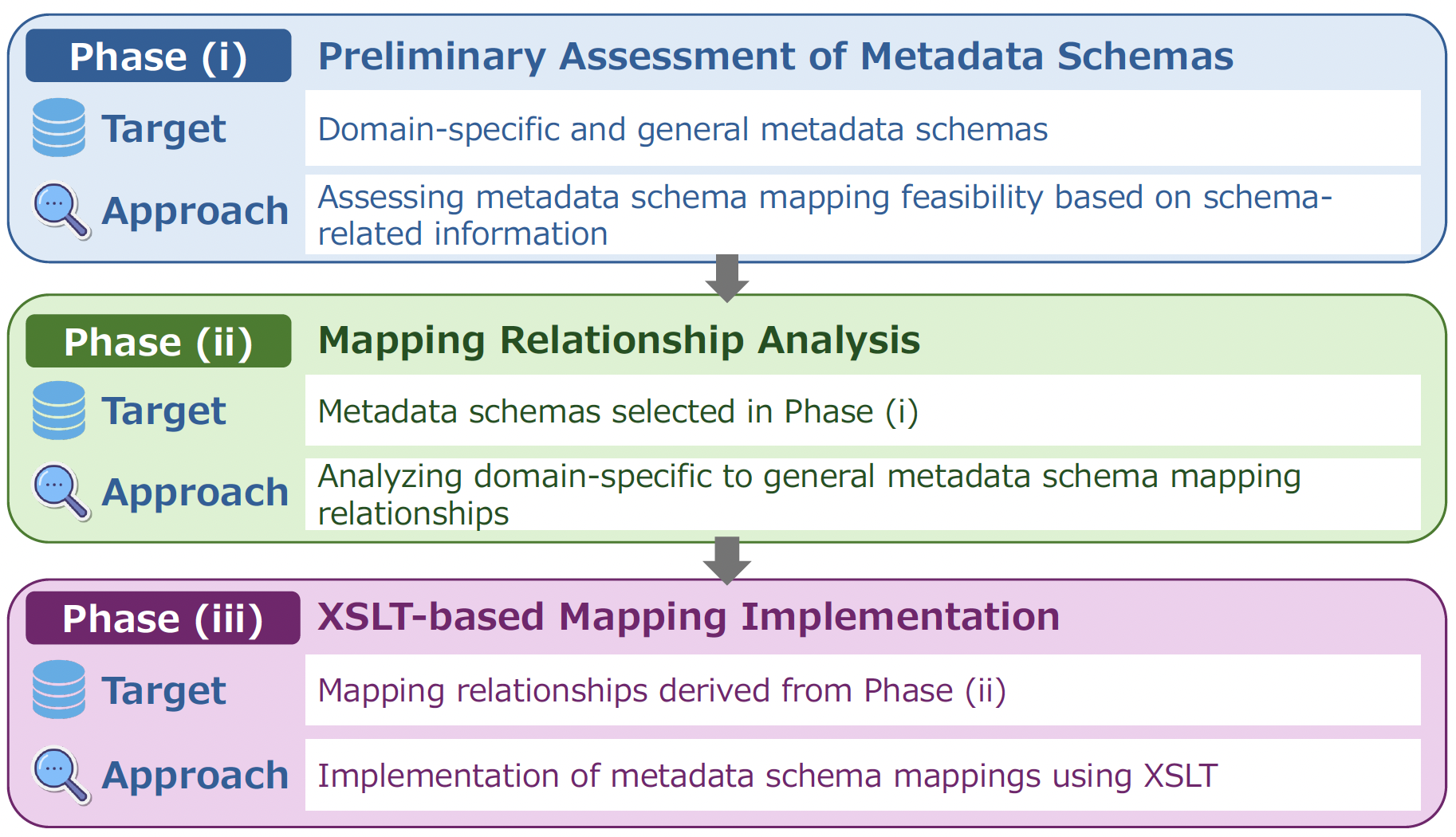
*Figure 1. Proposed Three-Phase Methodological Workflow*
## 3 Proposed Method
This section presents the proposed three-phase workflow.
The DataCite metadata schema[8] is adopted as the reference schema, and as illustrated in Figure 1, the workflow consists of three phases: (i) Preliminary Assessment of Metadata Schemas (Steps 1–2), (ii) Mapping Relationships Analysis, and (iii) XSLT-based Mapping Implementation.
### 3.1 Phase (i): Preliminary Assessment of Metadata Schemas
Phase (i) performs a preliminary assessment of metadata schemas based on the availability and quality of specification documentation.
This phase examines whether each schema provides sufficient documentation to support subsequent mapping analysis, and consists of Steps 1 and 2.
**Step 1: Defining Metadata Scope and Collecting Schema-related Information.**
This step collects schema-related information from both domain-specific and general-purpose metadata schemas and defines the mapping direction from domain-specific schemas to a general metadata schema.
For each selected schema, relevant documentation is collected, including specifications, official websites, and technical files such as XML Schema Definition (XSD).
**Step 2: Evaluating Usability based on Specification Documentation.**
This step is used to determine whether a schema is suitable for subsequent mapping analysis in Phase (ii).
Table 1 presents three criteria used to assess the usability of the selected metadata schemas.
These criteria are defined as follows: (1) Difficulty in information access, where documentation is missing, unclear, or dispersed, (2) Structural complexity, where the schema is divided into at least five modules, making it difficult to obtain an overall understanding, and (3) Model incompatibility, where structural or conceptual misalignment makes element-level mapping impossible (e.g., RDF-based schemas lacking a record-level entity corresponding to a DataCite resource), schemas where mapping was difficult but feasible were retained for Phase (ii).
| No | Exclusion Criteria | Description |
| --- | --- | --- |
| 1 | Difficulty in Information Access | - No access to specification contents or official websites. - Element definitions are missing or unclear. - Information is scattered or inconsistent across sources. |
| 2 | Structural Complexity† | - The schema is divided into at least five modules. - Element relationships depend on multiple namespaces or external references. - The overall structure is hard to understand, or mapping rules cannot be clearly defined. |
| 3 | Model Incompatibility | - Structural or conceptual misalignment makes element-level mapping impossible (e.g., RDF-based schemas lacking a record-level entity that could correspond to a DataCite resource). - Schemas where mapping was difficult but potentially feasible (e.g., requiring significant transformation logic) were retained and evaluated in Phase (ii). |
*Table 1. Metadata Selection Method*
† The threshold of five modules was determined based on the average number of modules observed across the surveyed multi-module metadata schemas.
Each schema was evaluated by the first author, who was responsible for the mapping process.
Cases involving uncertainty in the classification were reviewed through consultation with domain experts to reach a final decision.
Borderline cases that did not clearly satisfy any exclusion criterion were retained for re-evaluation in Phase (ii).
Schemas were classified as Model Incompatible only when structural or conceptual misalignment made element-level mapping to DataCite impossible, schemas where mapping was difficult but potentially feasible were retained for Phase (ii).
### 3.2 Phase (ii): Mapping Relationship Analysis
This phase analyzes the mappability between the selected metadata schemas and the DataCite metadata schema by examining their potential correspondence.
The analysis considers the following three aspects: (1) Lexical similarity, by comparing property names with corresponding DataCite properties, (2) Structural characteristics, including nested structures, repeatable elements, and overall schema organization, (3) Usage examples, by examining how each property is used in practice based on schema documentation.
Based on these aspects, each property is categorized into four mapping types[7]: (1) Fully matched (Yes) if it is semantically and structurally equivalent to a DataCite mandatory property.
(2) Partially matched — Type A if the conceptual meaning corresponds to a DataCite mandatory property, but differences in naming conventions or structural representation require transformation or interpretation.
(3) Partially matched — Type B if a similar property exists, but it does not fully satisfy DataCite requirements, such as the use of non-persistent or locally scoped identifiers instead of globally persistent identifiers.
(4) Not mappable (No) when no corresponding property can be identified.
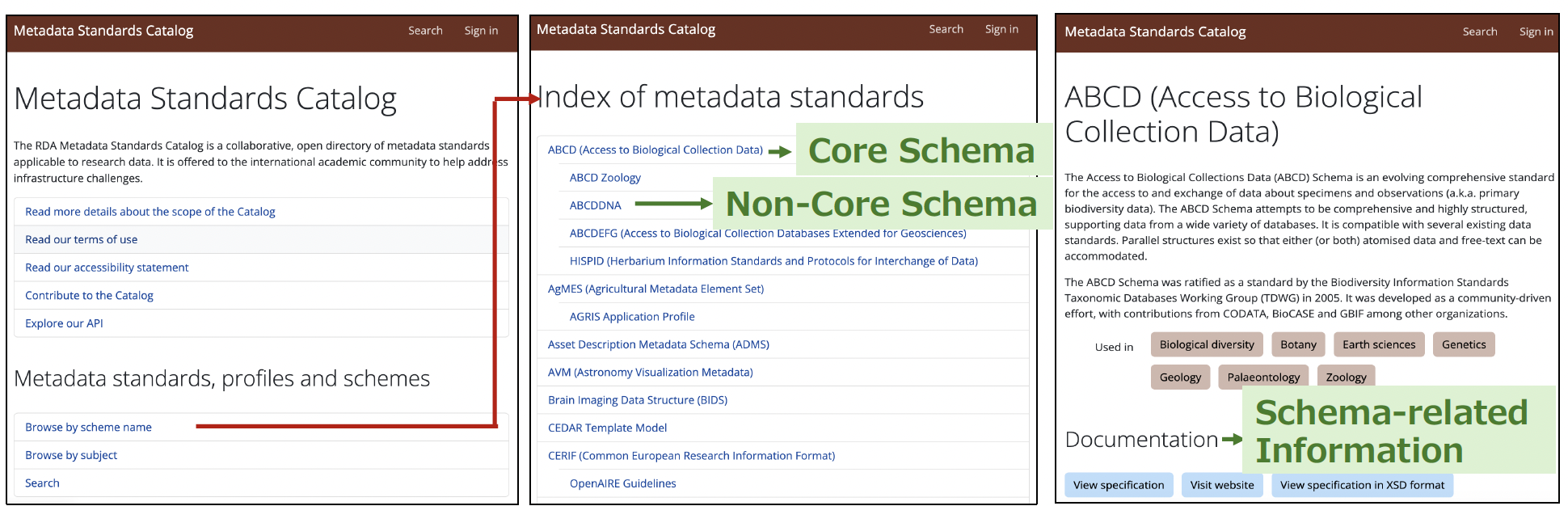
*Figure 2. The RDA Metadata Standards Catalog: interface[15] (left), Index of metadata standards[16] (center), and a metadata schema, ABCD[17] (right).*
### 3.3 Phase (iii): XSLT-Based Mapping Implementation
Phase (iii) serves as an initial proof-of-concept, demonstrating the feasibility of the proposed mapping approach through a single implementation case.
This phase implements the mapping relationships identified in Phase (ii) using XSL Transformations (XSLT)[18].
The selected metadata schemas are transformed into DataCite-compliant metadata using XSLT[18], a W3C standard language designed for XML document processing, including conditional transformation and iterative handling of repeated elements.
Based on the mapping categories identified in Phase (ii), different transformation strategies are applied during implementation.
Fully matched (Yes) properties are mapped directly to their corresponding DataCite properties.
Partially matched (Partial) properties require additional transformation logic, such as renaming, value conversion, or conditional processing.
For no mappable (No) properties, default values or alternative handling strategies are applied to ensure compliance with the DataCite metadata schema.
## 4 Evaluation and Results
This section presents the evaluation design and results based on a case study of the proposed three-phase workflow.
### 4.1 Evaluation Design
**RDA Metadata Standards Catalog.**
This study evaluates the proposed three-phase workflow through a case study based on the RDA Metadata Standards Catalog[19], which provides a diverse collection of domain-specific metadata schemas across multiple research domains.
The catalog contains 125 metadata schemas collected as of October 2025, covering multiple disciplines.
Figure 2 shows the catalog interface.
The left panel provides an overview of metadata standards, the center panel shows an index of metadata standards[16], and the right panel presents an example schema, ABCD (Access to Biological Collection Data)[17].
The center panel also distinguishes between core metadata and non-core metadata.
| Exclusion Criteria | Removed Count |
| --- | --- |
| Schema-related information investigation | 64 |
| Difficulty in information access | 27 |
| Structural complexity | 11 |
| Model incompatibility | 13 |
| Remaining Metadata: 10 | |
*Table 2. Evaluation of Phase (i)*
**DataCite Metadata Schema.**
The DataCite metadata schema[20] is an international metadata standard for research data citation and discovery, enabling persistent identification, access, and reuse of research outputs.
Its metadata model defines mandatory, recommended, and optional properties.
This study focuses on six mandatory properties: "identifier", "creator", "title", "publisher", "publicationYear", and "resourceType".
DataCite was selected due to its widespread adoption in research repositories, support for DOI infrastructure, strong community governance, and alignment with the FAIR principles, making it suitable as a target model for cross-domain metadata mapping.
**Evaluation Criteria.**
The evaluation is structured according to the three phases of the proposed workflow and is designed to assess the effectiveness of each phase.
Phase (i) evaluates whether metadata schemas can be effectively selected based on the usability of specification documentation, including availability and structural clarity.
Phase (ii) evaluates the ability to identify correspondences between metadata schemas and the DataCite metadata schema.
Phase (iii) evaluates whether the identified mapping relationships can be correctly implemented using XSLT, and whether the resulting transformation is consistent with the DataCite metadata schema.
| No | Remaining Metadata | Academic Fields | Specification | Website | XSD File |
| --- | --- | --- | --- | --- | --- |
| 1 | ABCD | Biological diversity | ✓ | ✓ | ✓ |
| 2 | AVM | Astronomy | | ✓ | |
| 3 | CSMD | Biochemistry | | ✓ | |
| 4 | Darwin Core | Biological diversity | ✓ | ✓ | |
| 5 | DDI | Social sciences | ✓ | ✓ | |
| 6 | EML | Biological diversity | ✓ | ✓ | |
| 7 | Protocol Data Element Definitions | Clinical medicine | ✓ | ✓ | |
| 8 | UKEOF | Climatology | ✓ | ✓ | |
| 9 | EURISCO Descriptors | Plant Genetic Resources | | ✓ | |
| 10 | BIDS | Neurobiology | ✓ | ✓ | |
*Table 3. Specification availability of 10 remaining metadata schemas from Phase (i)*
### 4.2 Evaluation Results of Phase (i)
Candidate metadata schemas were identified through Phase (i): Preliminary assessment of metadata schemas.
The evaluation results are presented in Table 2.
After the initial survey, 61 schemas were retained for further analysis.
Of these, 27 were excluded due to difficulty in accessing information, 11 due to structural complexity, and 13 due to model incompatibility, leaving 10 metadata schemas for Phase (ii).
| Metadata | Identifier | Creator | Title | Publisher | PublicationYear | ResourceType |
| --- | --- | --- | --- | --- | --- | --- |
| ABCD | Partial | Yes | Yes | No | No | No |
| AVM | Partial | Yes | Yes | Yes | Yes | No |
| CSMD | Yes | Yes | Yes | Yes | Yes | No |
| Darwin Core | Partial | Yes | Yes | Yes | Yes | No |
| DDI | Partial | Yes | Yes | Yes | Yes | No |
| EML | Partial | Yes | Yes | Yes | Yes | No |
| Protocol Data Element Definitions | Partial | Yes | Yes | Yes | Yes | No |
| UKEOF | Partial | Yes | Yes | Yes | Yes | No |
| EURISCO Descriptors | Partial | Yes | Yes | Yes | Yes | No |
| BIDS | Yes | Yes | Yes | Partial | Partial | No |
*Table 4. Mapping Results of 10 Remaining Metadata Schemas (Yes = fully matched, Partial = partially matched, No = no matched)*
Table 3 summarizes the 10 remaining schemas, including their academic fields and the availability of specifications, website information, and XSD files.
A checkmark (✓) indicates availability of the corresponding resource.
The results indicate variation in the level of schema-related information across the remaining schemas.
For instance, ABCD[17] provides complete documentation, including specifications, website information, and XSD files.
Such comprehensive documentation is more likely to facilitate alignment with other metadata in related analyses.
In contrast, AVM[21], CSMD[22], and EURISCO Descriptors[29] lack formal specification documents.
Nevertheless, all retained schemas provide at least basic web-accessible documentation, ensuring minimum usability for subsequent analysis.
| No. | DataCite Properties | Mapping Result | EML Element Path |
| --- | --- | --- | --- |
| 1 | Identifier | Partial | Only DOIs |
| 2 | Creator | Yes | eml \> dataset \> creator |
| 3 | Title | Yes | eml \> dataset \> title |
| 4 | Publisher | Yes | eml \> dataset \> publisher \> organizationName \> value |
| 5 | PublicationYear | Yes | eml \> dataset \> pubDate |
| 6 | ResourceType | No | - |
*Table 5. Mapping Example from EML to the DataCite metadata schema*
### 4.3 Evaluation Results of Phase (ii)
Table 4 shows the mapping results for the 10 remaining metadata schemas in Phase (ii) against the six mandatory properties of the DataCite metadata schema.
Overall, most schemas support the properties "creator", "title", "publisher", and "publicationYear".
For the "identifier" property, CSMD and BIDS are classified as "Yes", as both schemas explicitly support persistent identifiers, including DOI-based identifiers.
The remaining eight schemas are classified as "Partial", reflecting two distinct cases: some schemas provide only locally scoped identifiers rather than globally persistent identifiers (Type B), while others allow DOI-formatted values but do not explicitly require persistent identification (Type A).
In contrast, "resourceType" is not supported by any of the evaluated schemas.
These findings indicate a significant gap in interoperability, highlighting the need for better alignment with global identifier standards and potential extension of existing schemas to support properties such as "identifier" and "resourceType".
### 4.4 Evaluation Results of Phase (iii) Based on an EML Mapping Example
To validate Phase (iii), this study uses EML[25] as a case study.
EML is widely used in ecology and environmental science and is adopted by major biodiversity platforms such as GBIF[30][31], making it suitable for evaluating metadata transformation.
In this case study, Phase (iii) is applied based on the mapping relationships identified in Phase (ii), and the corresponding transformation rules are implemented using XSLT.
Table 5 presents the mapping results from EML to the DataCite metadata schema for the six mandatory properties.
The results show that "title" and "creator" in EML are directly mapped to "title" and "creator" in DataCite, while value of "publisher" and "pubDate" are mapped to "publisher" and "publicationYear", respectively.
In contrast, "identifier" is only partially supported due to its reliance on DOI-based representation, and "resourceType" cannot be directly mapped from EML.
Based on these mappings, an XSLT transformation file was developed and is available in a GitHub repository.[^1]
## 5 Discussion
**Factors Affecting Metadata Mapping.**
The evaluation reveals that the availability and clarity of metadata documentation are key factors affecting the feasibility of the workflow, particularly for element-level mapping.
These factors influence the overall performance of the workflow across all phases.
A notable finding of Phase (i) is that more than half of the surveyed schemas (64 out of 125, 51.2%) could not proceed to detailed analysis because of insufficient or inaccessible documentation.
Among these cases, 27 were due to inaccessible information, 11 to structural complexity, and 13 to model incompatibility.
These findings suggest that the exclusion rate reflects not only a limitation of the present methodology, but also a broader structural issue in current metadata ecosystems.
Even among the 10 selected schemas, documentation gaps persisted, particularly for the "identifier" and "resourceType" properties.
These observations indicate that inconsistencies in metadata design and documentation practices reduce the reliability of cross-schema mapping, while comprehensive documentation, as seen in ABCD[17], facilitates more reliable alignment.
In Phase (ii), while the DataCite metadata schema provides a widely adopted interoperability baseline, its fixed structure may not fully capture domain-specific nuances, which can lead to partial mismatches during alignment.
**Recommendations and Limitations.**
Based on the findings of this study, several recommendations are proposed to improve metadata interoperability.
These include providing clear schema-related information, such as formal specifications and machine-readable formats, ensuring accessible documentation, and promoting systematic mapping workflows.
The study also has limitations.
In particular, lower mapping success for properties such as "identifier" and "resourceType" may reflect both limitations in source schemas and constraints in the DataCite metadata schema in representing domain-specific information.
## 6 Conclusion and Future Research
This study proposes a systematic three-phase workflow for cross-domain metadata mapping, evaluated through a case study of 125 schemas.
The results revealed persistent gaps in "identifier" and "resourceType", and an EML-to-DataCite XSLT transformation demonstrated the practical feasibility of the workflow.
Although the proposed workflow was informed by the analysis of multiple schemas, only the final phase, the XSLT-based mapping implementation, was evaluated using a single schema-mapping case.
Therefore, the findings related to this phase should be interpreted within that context.
Future work will extend the evaluation to additional cases and schema collections, such as FAIRsharing, to assess the applicability of the approach across a wider range of metadata standards.
Further investigation of the inter-rater reliability of the mapping categorization scheme will also be conducted.
## Acknowledgments
This research was supported by MEXT Project "Developing a Research Data Ecosystem for the Promotion of Data-Driven Science".
We thank Mr.
Nobuya Okayama and Mr.
Kazumasa Iwasaki for their cooperation, as well as all members of the project's Rules-Guidelines Development Team for their valuable support and contributions.
## References
1. FORCE11. *The FAIR Data Principles*. 2016. [https://force11.org/info/the-fair-data-principles/](https://force11.org/info/the-fair-data-principles/).
2. P. Suber. *Open Access*. The MIT Press, 2012. [https://doi.org/10.7551/mitpress/9286.003.0001](https://doi.org/10.7551/mitpress/9286.003.0001).
3. M. Demleitner. *VOResource and DataCite: Converging metadata schemes*. EPJ Web of Conferences, International Conference on Exotic Atoms and Related Topics, vol. 186, 5, 2018. [https://doi.org/10.1051/epjconf/201818101001](https://doi.org/10.1051/epjconf/201818101001).
4. M. Nose, A. Shinbori, Y. Miyoshi, T. Hori, T. Ohira, J. Hashiba, C. Naoe, R. Gakiya, M. Okamoto, T. Sagara, T. Aoki, S. Matsubara, I. Takahashi, H. Hayashi, K. Yamada, Y. Minamiyama, Y. Tanaka, S. Abe, S. UeNo, S. Imajo, Y. Saito, T. Ashikita, Y. Hori, T. Shimizu, N. Okamura, K. Hirano, and L. Bargatze. *Enhancing findability and searchability of research data: Metadata conversion and registration in institutional repositories*. Data Science Journal, vol. 23, 2024. [https://doi.org/10.5334/dsj-2024-040](https://doi.org/10.5334/dsj-2024-040).
5. C. Kakali, I. Lourdi, T. Stasinopoulou, L. Bountouri, C. Papatheodorou, M. Doerr, and M. Gergatsoulis. *Integrating Dublin Core metadata for cultural heritage collections using ontologies*. vol. 2007, 2007. [https://doi.org/10.23106/dcmi.952108714](https://doi.org/10.23106/dcmi.952108714).
6. T. Stasinopoulou, L. Bountouri, C. Kakali, I. Lourdi, C. Papatheodorou, M. Doerr, and M. Gergatsoulis. *Ontology-based metadata integration in the cultural heritage domain*. In Proceedings of the International Conference on Asian Digital Libraries (ICADL), vol. 4822, Springer, pp. 165–175, 2007. [https://doi.org/10.1007/978-3-540-77094-7\_25](https://doi.org/10.1007/978-3-540-77094-7_25).
7. Y. Cong, M. Takaku, Y. Minamiyama, T. Aoki, and S. Matsubara. *A preliminary study on metadata compatibility and automatic conversion among LOD datasets*. Proceedings of DCMI 2025, 2025. [https://doi.org/10.23106/dcmi.952519392](https://doi.org/10.23106/dcmi.952519392).
8. DataCite. *DataCite Metadata Schema Properties*. 2025. [https://datacite-metadata-schema.readthedocs.io/en/latest/properties/](https://datacite-metadata-schema.readthedocs.io/en/latest/properties/).
9. J. Greenberg. *Understanding metadata and metadata schemes*. Cataloging & Classification Quarterly, vol. 40, pp. 17–36, 2005.
10. M. Doerr. *The CIDOC conceptual reference model: An ontological approach to semantic interoperability of metadata*. AI Magazine, vol. 24, pp. 75–92, 2003.
11. M. L. Zeng and J. Qin. *Metadata*. 2nd ed., ALA Neal-Schuman, 2016.
12. SPASE Consortium. *SPASE Data Model*. 2026. [https://spase-group.org/data/index.html](https://spase-group.org/data/index.html).
13. National Institute of Informatics, Japan. *JPCOAR Schema*. 2025. [https://schema.irdb.nii.ac.jp/en/schema](https://schema.irdb.nii.ac.jp/en/schema).
14. L. Bountouri and M. Gergatsoulis. *The semantic mapping of archival metadata to the CIDOC CRM ontology*. Journal of Archival Organization, vol. 9, pp. 174–207, 2011.
15. Research Data Alliance. *Research Data Alliance*. 2025. [https://www.rd-alliance.org/](https://www.rd-alliance.org/).
16. RDA Metadata Standards Catalog Working Group. *Index of Metadata Standards*. 2025. [https://rdamsc.bath.ac.uk/scheme-index](https://rdamsc.bath.ac.uk/scheme-index).
17. Biodiversity Information Standards (TDWG). *Access to Biological Collection Data (ABCD)*. 2005. [https://rdamsc.bath.ac.uk/msc/m1](https://rdamsc.bath.ac.uk/msc/m1).
18. World Wide Web Consortium. *XSL Transformations (XSLT) Version 1.0*. W3C Recommendation, 1999. [https://www.w3.org/TR/xslt-10/](https://www.w3.org/TR/xslt-10/).
19. RDA Metadata Standards Catalog Working Group. *Metadata Standards Catalog*. 2025. [https://rdamsc.bath.ac.uk/](https://rdamsc.bath.ac.uk/).
20. DataCite Metadata Working Group. *DataCite Metadata Schema for the Publication and Citation of Research Data and Other Research Outputs. Version 4.6*. 2024. [https://doi.org/10.14454/mzv1-5b55](https://doi.org/10.14454/mzv1-5b55).
21. R. Hurt, L. Lindberg Christensen, and A. Gauthier. *Astronomy Visualization Metadata (AVM)*. 2025. [https://www.virtualastronomy.org/avm\_metadata.php](https://www.virtualastronomy.org/avm_metadata.php).
22. *Core Scientific Metadata Model (CSMD)*. 2025. [https://icatproject-contrib.github.io/CSMD/](https://icatproject-contrib.github.io/CSMD/).
23. Biodiversity Information Standards (TDWG). *Darwin Core Standard*. 2023. [https://www.tdwg.org/standards/dwc/](https://www.tdwg.org/standards/dwc/).
24. *About the DDI Alliance*. 2024. [https://ddialliance.org/about-the-alliance](https://ddialliance.org/about-the-alliance).
25. M. B. Jones, M. O'Brien, B. Mecum, C. Boettiger, M. Schildhauer, M. Maier, T. Whiteaker, S. Earl, and S. Chong. *Ecological Metadata Language version 2.2.0*. 2019. [https://doi.org/10.5063/F11834T2](https://doi.org/10.5063/F11834T2).
26. U.S. National Library of Medicine. *Protocol Definitions*. 2025. [https://clinicaltrials.gov/policy/protocol-definitions](https://clinicaltrials.gov/policy/protocol-definitions).
27. UK Environmental Observation Framework (UKEOF). *UK Environmental Observation Framework*. 2025. [https://ukeof.org.uk/](https://ukeof.org.uk/).
28. BIDS Community. *Brain Imaging Data Structure (BIDS)*. 2025. [https://bids.neuroimaging.io/index.html](https://bids.neuroimaging.io/index.html).
29. RDA Metadata Standards Catalog Working Group. *EURISCO Descriptors*. 2025. [https://rdamsc.bath.ac.uk/msc/m85](https://rdamsc.bath.ac.uk/msc/m85).
30. Global Biodiversity Information Facility (GBIF). *GBIF: Global Biodiversity Information Facility*. 2026. [https://www.gbif.org/](https://www.gbif.org/).
31. Global Biodiversity Information Facility (GBIF). *Data standards*. 2026. [https://www.gbif.org/standards](https://www.gbif.org/standards).
## Notes
[^1]: [https://github.com/juliayc/Discipline-DataCite](https://github.com/juliayc/Discipline-DataCite)